
Where IT All Began

"A long time ago in a galaxy far, far away...."
This post is a curriculum vitae of sorts on how this venture came to be. It's an amalgamation of both personal and professional experiences that lend themselves to skills and lessons learned and general opinions on how technology affects our lives, with a little sporadic humor. (The IT in the post title being a punny reference to I.T.)
It really did all begin in the basement of my parents' home on an i386 machine running Windows 3.1 in the early 1990s. My first experience with a command line was MS-DOS running Number Munchers off a 3.5" floppy disk (A:\) at the age of five. The foundation of math education and keyboard navigation I was building at the time was instrumental in the years that followed. With each iteration of the Windows operating system reading documentation and release notes became habit and expanded that foundation.
Middle School
The media centers and libraries in school helped solidify the notion that technology would evermore be utilized and engrained in our lives. Navigation and customization of operating systems evolved into intricate spreadsheet formulas in Excel and database queries in Access. My middle school computer lab exclusively used the iMac G3, my first experience with the PC vs. Mac "war", which introduced me to Mac OS 8 (and Zip drives). The dichotomy of Apple and Microsoft in the personal computing world in the early 2000s was the first time I ever had to think about competing ideologies in technology. For myself at the time neither one was particularly better for what I needed to accomplish. However, the process of having to learn another product laid the groundwork for the questions I now ask myself during a comparative critical analysis.
It was also around this time that I realized I needed more powerful (and increased capacity) hardware. Until this point I had been using hand-me-down equipment from my father after his own upgrades. There was a monthly computer trade show at a local civic center and I was able to find a Compaq case and all the innards within my budget, my first own computer and, embarrassingly, the first one I ever built. Thinking back, it's hard to believe it took that long but the floodgates have been open since and there's more hardware in storage now than I'd like to admit.
High School
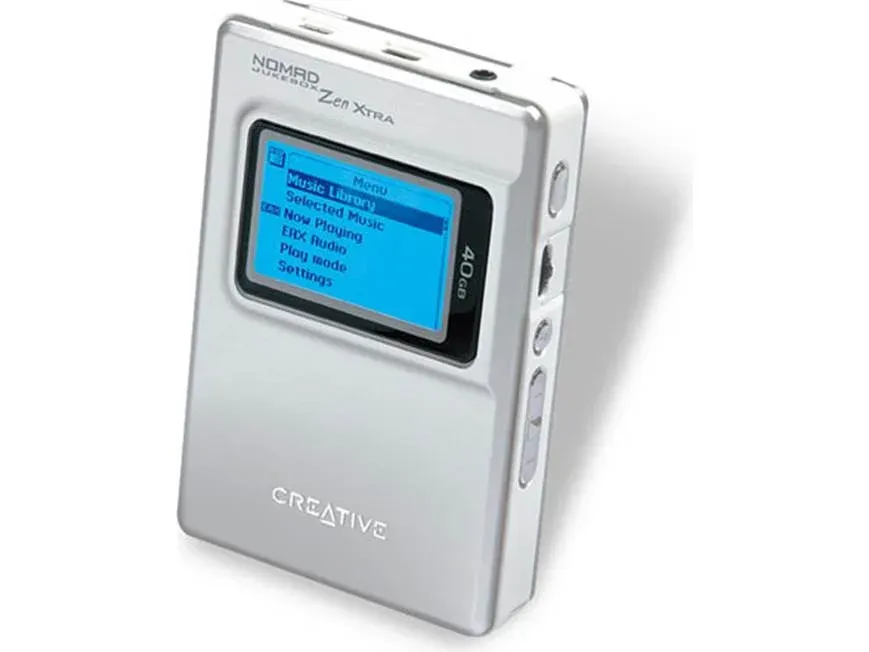
High school brought about exponential technological growth, both personally and societally. MP3 players had been generally available for a few years at this point but personal electronic devices were gaining popularity and it became habit to carry more of them around. Never happy with the song quantity limitations of the smaller 128MB to 1GB players I had previously owned I opted to purchase a Creative NOMAD. At 40GB I could bring my entire music collection with me wherever I went in a conservative 3.5in form factor. Essentially I was carrying around a desktop hard drive in my pocket. Thank goodness for cargo pants/shorts.
Most of my math courses required a graphing calculator and nearly all my classmates made it through them with only a TI-83 Plus, which was a good introduction to these types of devices but it didn't satisfy my curiosity or academic needs. Eventually I would add the TI-84 Plus Silver Edition and TI-89 Titanium to my collection. I quickly became tired of the tedious and repetitive nature of punching in the same calculations for the same formulas just with different numbers, so I learned TI-BASIC (the BASIC derivative created by Texas Instruments) and wrote programs to make the calculators work in my favor. Turning a math formula on paper into code helped improve my understanding of the concepts and relationships between the numbers, esssentially forcing me to learn what I needed to. It also made completing the homework and tests much quicker, which left more time for playing calculator games. That was always the ultimate goal.
My foray into academic computer classes was also in high school with Computer Maintenance and Repair, Computer Networking, and Web Page Design. Unfortunately the class I really wanted to take, AP Computer Science Principles, didn't have a large enough enrollment thus was dropped from the course catalog each time I attempted to register. Fortunately by this time there was no shortage of hobby projects and business ventures to focus on. I had begun to freelance computer repair and upgrades (mostly increasing RAM and networking printers) for friends and family and it was the first time my work with technology moved from personal to professional.
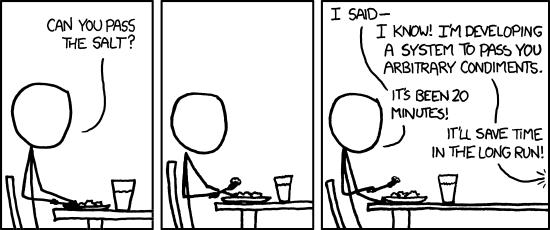
As with any business there's an imperative to manage it by keeping track of information, inventory, finances, etc. I put into practice some of the knowledge I had learned and cobbled together a web application (HTML, CSS, JavaScript, PHP and MySQL) that would track my work and kick out PDF invoices for customers. Again, it was all about using technology to make everything I was doing easier. I was learning about Management Information Systems (MIS) before I even learned what those are in school.
College
In college I began to meet numerous people who had practical, real world experience in their careers with programming and technology. It was here I got to see best practices put into action and I learned how to shepherd projects from ideation to proof of concept to end users. It was also here that I had my first run-in with C++, I had never needed to use it before. Following that came Java, Visual Basic, and C#, all different tools and philosophies.
Professional Career
TigerDirect, Computer Techs
After college I worked at TigerDirect, an electronics, computers, and computer components retail chain, and a small family-owned computer repair shop named Computer Techs. I held several different positions at Tiger but toward the end of my tenure I was in the service department repairing and upgrading computers. At the time there was no centralized work order system for the company so I helped build out and improve our own, and did the same at Computer Techs.
Urban Communications
After a few years there I moved to a small wireless ISP (Internet Service Provider), Urban Communications. My main role there was support technician, but it was such a small company that I wore a few different hats. I had plenty of experience with consumer electronics but now I was thrown into a day-to-day that involved more advanced commercial equipment like:
- Cisco routers
- DragonWave microwave transmission radios
- Alvarion transmitters/receivers
- Polycom telepresence systems
- Barracuda firewalls/load balancers
- Axis IP cameras
I enjoyed the variety of work this job offered and on a weekly basis I found myself doing things like technical support, web development, configuring radio equipment, and assisting our field technician/tower climber with installations and maintenance.
Redbox Automated Retail
From that small outfit of under ten employees my professional life took a big swing in the other direction and suddenly I had hundreds of coworkers at Redbox Automated Retail. Yes, the red DVD rental kiosks. I began in the Machine Support department as a Level 1 Technician remotely troubleshooting machines and assisting field technicians across the country. Within the first year I joined the QA team because of my programming skills and eventually took the helm from the select few before me who built the ship. They received reports from the Business Intelligence team and created automated dashboards that prioritized the kiosks that needed attention. The technicians would then work the dashboards and create tickets in BMC Remedy. Eventually we built a system we creatively named Automation that would automatically create these tickets with the pertinent information and the techs would then assign themseves a ticket, thus eliminating many manual steps and saving hundreds of hours of work a year. When the company expanded into Canada I built a site based on our U.S. kiosk management system that tracked kiosk information and allowed our techs to dispatch field personnel.
Working on these systems proved my technical acumen and I followed the path of colleagues before me to the Software Operations team. While the team was largely responsible for resolving escalations from Machine Support, we also interfaced with numerous other departments and provided insight and empirical and quantitative evidence for changes to the kiosks, both bugfixes and new features. It was also our responsibility to track large company-wide initiatives such as computer/operating system upgrades. Maintaining numerous data points on over 44,000 machines tested the limits of my scripting skills and then extended them.
I was also afforded the opportunity to visit Bellevue, Washington for a week and work with the SampleIt team on establishing a support system for their kiosk and operations. Redbox's parent company (Coinstar, then the restructured Outerwall) was trying to expand its catalog of offerings beyond just coin counting and DVD rental kiosks. This new machine would allow users to purchase a small sample of various healthcare and beauty products and could also print a coupon for the full size product. They were leveraging the existing infrastructure and teams so I flew out and trained with the hardware and software engineers. Upon my return I cross-trained a few of my teammates and then set up a mechanism by which the kiosks would receive regular software updates from the development team.
On the next step of my journey I became a DevOps Engineer. DevOps being a philosophy and set of tools that integrates software engineering, operations, and quality assurance I once again found myself with a day-to-day that could vary greatly in scope. I was paired with a coworker and it was the two of us who were responsible for Corporate Systems, a suite of internal sites and applications used by employees to manage a wide range of information. We were responsible for maintaining deployments, uptime, and performance and it introduced me to many other software tools like:
- ExactTarget (digital marketing platform, now Salesforce Marketing Cloud)
- ExtraHop (network traffic monitor)
- F5 Networks (load balancer)
- GroupID (Active Directory and Azure AD management)
- Jenkins (continuous integration/continuous delivery automation server)
- Micosoft Team Foundation Server (software version control, build server, work item tracker)
- Octopus Deploy (automated deployment server)
- ProGet (package manager, container repository)
- Splunk (log aggregation and application performance monitoring)
- Tableau (business intelligence and analytics)
- vSphere (virtual machine platform)
- Zabbix (network, application, server monitor)
As time went on and leadership changed we began to adopt more modern approaches to what we were doing like cloud infrastructure and observability. Our team pivoted from traditional DevOps practices to a more hands-on role in the development process. We shifted to a Site Reliability Engineering (SRE) mindset and focused more on application reliability and performance. If we could improve the software to use fewer resources and be faster then we would need less infrastructure and end users would be better satisfied. Our tooling evolved also and we started using:
- Confluence (wiki and collaboration platform)
- GitLab (code repository, version control, build pipelines)
- Grafana (data visualization and monitoring platform)
- Jira (project management and issue-tracking)
- Prometheus (time-series metrics aggregator)
Toward the end of my employment at Redbox I found myself writing code that ended up in production systems, not just building deployment and infrastructure pipelines. The first day I hit Enter and watched as my code compiled and began to make its way through the wires I reflected on my own journey to that point. I took immense pride in where I was at that moment, a software developer.
Conway Technology Offerings
The work I do now is the culmination of decades of learning, experience, trials, and failures. Unfortunately Redbox suddenly ceased operations but there was a silver lining. For the first time in 13 years I was forced to think about what I wanted to do next career-wise. I had already established an LLC years before for side work and other ventures so it became evident I just had to lean into that and keep doing what I had been doing for so long, use technology to solve problems and provide value for users.
So here I am, offering my experience and services to those who need it. Whether a company needs a simple online presence or an advanced automated solution customized for their business it can be done. Even the smallest changes can have a large impact, saving minutes a day eventually adds up to hundreds of hours. If you're a small business owner looking to improve your daily operations we can help. Remember, if you perform a task manually more than twice, it should be automated to save time, reduce human error, and increase efficiency.
Thank you for reading.
William Conway